
When people talk about “sustainable living,” the conversation usually turns expensive fast. Organic everything. Tesla in the driveway. Those designer bamboo products that somehow cost three times what the plastic version does.
But what if I told you sustainable living is actually one of the smartest financial moves you can make?
Because here’s what nobody mentions when they’re selling you on eco-friendly lifestyles: the planet doesn’t care about expensive virtue signaling. Real sustainability means using less. And using less—whether it’s energy, water, food, or stuff—directly translates to spending less.
This isn’t about deprivation or going back to living in caves. It’s about recognizing that most of our wasteful habits aren’t making us happier anyway—they’re just making us broker and trashing the environment in the process.
Ready to keep more money in your account while actually making a difference? Let’s dig into the habits that deliver on both fronts.
Why Less Really Is More (For Your Wallet and the Planet)
The connection between sustainability and savings isn’t complicated. Every time you flip a light switch unnecessarily, you’re paying for electricity you didn’t need. Every grocery item that rots in your fridge represents money you threw away. Every cheap product that breaks after three uses is money you’ll spend again.
Sustainable living forces you to ask one critical question before every purchase and action: “Do I actually need this?”
That question is kryptonite to wasteful spending.
The environmental movement and financial independence community have been saying the same thing for years, just using different vocabulary. Minimalists call it “intentional living.” Environmentalists call it “reducing your footprint.” Frugal folks call it “being smart with money.”
It’s all the same thing.
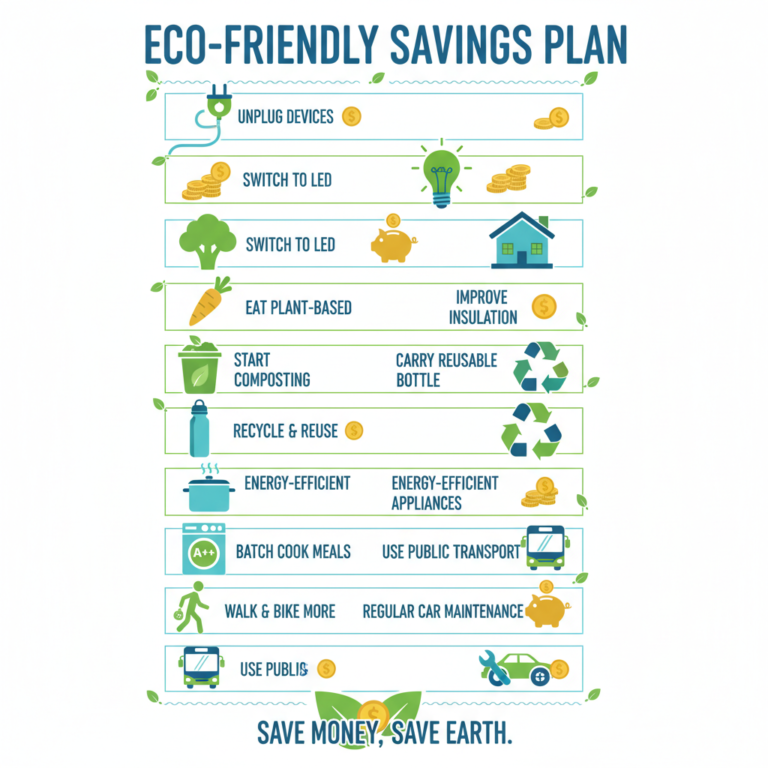
20 Habits That Prove Green Living Saves Green
1. Kill the Energy Vampires
Your devices are draining your bank account while you sleep. Standby power—that little red light on your TV, the phone charger plugged in with nothing attached, the microwave clock you never look at—accounts for up to 10% of residential electricity use.
Translation? You’re paying £50-100 annually for absolutely nothing.
The fix costs zero pounds: turn things off at the wall. Unplug chargers when you’re not using them. Put energy-hungry devices on power strips so you can kill multiple vampires with one switch.
This is the lowest-hanging fruit on the money-saving tree. Pick it.
2. Switch to LEDs (Just Do It Already)
Yes, LED bulbs cost more upfront. A tenner for a light bulb feels wrong when you can get an incandescent for £1.
But that £1 bulb will burn out in a year while guzzling electricity. The LED will still be going strong 15 years from now while using 75% less power.
Replace ten frequently-used bulbs and you’ll save roughly £180 per year on electricity. That’s £2,700 over those 15 years. For the same amount of light.
This isn’t even a debate at this point.
3. Insulate Like Your Money Depends On It (Because It Does)
Heating and cooling a poorly insulated home is like trying to fill a bathtub with the drain open. You’re just burning money to heat the atmosphere.
Proper loft insulation can cut heating bills by £250 annually. It typically pays for itself in 2-4 years, then keeps saving you money for decades.
Many governments offer grants covering part of the cost. This is literally free money to help you save more money while staying warmer in winter and cooler in summer.
4. Eat More Plants (Your Body and Budget Will Thank You)
Meat is expensive. Ridiculously expensive when you look at cost per gram of protein.
Dried lentils: £1.50 per kilogram. Ground beef: £6-10 per kilogram.
Both deliver protein. One costs a fraction of the other while producing dramatically less environmental impact.
You don’t need to become a strict vegan. But swapping even two or three meat-heavy meals per week for plant-based alternatives can slash your grocery bill by 15-30%. For a family of four, that’s £100-200 monthly.
That’s holiday money. Or emergency fund money. Or “finally paying off that credit card” money.
5. Stop Throwing Money in the Bin
The average UK household tosses £470 worth of edible food annually. Just… throws it away.
That’s not a carbon footprint issue or a moral failing. That’s a financial hemorrhage.
The fix? Meal planning. Boring, I know. But spending 30 minutes on Sunday planning your week’s meals, checking what you already have, and shopping with a list prevents impulse purchases and ensures you actually eat what you buy.
Freeze leftovers instead of letting them turn into science experiments in the back of your fridge. Learn which foods last longest and eat the perishable stuff first.
This single habit can save you hundreds of pounds annually while cutting your food waste by half or more.
6. Compost Your Scraps
Even with perfect planning, you’ll have food scraps. Vegetable peelings, coffee grounds, eggshells—stuff you can’t eat but can use.
Composting turns garbage into gold (well, into rich soil that’s basically gold if you garden or have houseplants). You’ll never buy fertilizer or soil amendments again.
No garden? Many communities have composting programs. Worst case, you’re keeping organic waste out of landfills where it produces methane, a greenhouse gas far worse than CO2.
7. Recycle, Repurpose, Resell—But Never Just Trash
Before anything goes in your bin, pause. Can it be recycled? Repurposed? Sold? Donated?
That broken furniture might be someone’s DIY project. Those clothes you never wear could sell on Vinted or go to a charity shop. That old phone has value for parts and materials.
Some recycling centers actually pay for certain materials. Selling items you no longer need puts cash in your pocket. Even donations generate tax deductions if you itemize.
Treating trash as a last resort, not a first option, keeps useful items circulating while keeping money from leaking out of your budget.
8. Ditch Single-Use Everything
Calculate what you spend yearly on bottled water, disposable coffee cups, plastic bags, sandwich bags, paper towels, disposable razors.
Go on, actually add it up. I’ll wait.
Shocking, right?
A £15 reusable water bottle eliminates buying bottled water forever. A £10 coffee thermos pays for itself in a week if you’re a daily café visitor. Reusable shopping bags, produce bags, and food containers prevent recurring waste.
The upfront cost feels like spending, but you’re actually buying back all that future waste money.
9. Choose Efficiency When Appliances Die
When your refrigerator finally gives up, you’ll need a replacement. This is when energy ratings matter enormously.
A highly efficient model costs £100-200 more than a basic one but uses £50-100 less electricity annually. Over its 10-15 year lifespan, the efficient model actually costs hundreds less while reducing environmental impact.
This applies to washing machines, dishwashers, water heaters—anything that runs constantly or frequently. Pay attention to energy labels and do the math on operating costs, not just purchase price.
10. Use the Right Appliance for the Job
Your oven is an energy hog. Microwaves use roughly half the power for many cooking tasks. Air fryers and slow cookers are similarly efficient.
Heating a full oven to cook one potato is absurd when you could microwave it in six minutes using a fraction of the energy. Same result, lower bill.
Match your cooking method to your task. Save the oven for when you actually need it.
Transportation: Where Small Changes Mean Big Savings
11. Walk or Bike When You Can
Cars cost roughly £1.50-2.00 per mile when you account for everything: fuel, insurance, maintenance, depreciation, parking.
Walking costs nothing. Biking costs nearly nothing once you own the bike.
For trips under two or three miles, choosing active transportation saves money, improves your health, and eliminates emissions entirely. Replace just 10% of your car trips and you could save several hundred pounds annually while getting fitter.
12. Take Public Transport
One bus carrying 40 people is more efficient than 40 cars carrying one person each—both environmentally and financially.
A monthly transit pass typically costs less than a week’s worth of fuel and parking. People who switch from daily driving to public transport often save £200-400 monthly.
That’s £2,400-4,800 annually. That’s serious money.
13. Actually Maintain Your Car
If you must