The irony isn’t lost on me. Here we are, trying to combat climate change while living in places where the temperature regularly hits 40°C—and sometimes we’re doing it by running air conditioners that burn through more electricity than a small factory.
I’ve spent the last decade working with homeowners, architects, and communities in scorching climates from Arizona to Abu Dhabi. The conversation always starts the same way: “I want to be more sustainable, but I also don’t want to melt.” Fair enough.
Here’s what I’ve learned: the ancient Persians, Bedouins, and Indigenous peoples of hot regions figured this out centuries ago. They built homes that stayed cool without a single kilowatt of electricity. Modern technology has only expanded these possibilities.
This isn’t about suffering through heat waves with a hand fan while feeling morally superior. It’s about building systems that actually work—for you, your wallet, and the planet.
The Real Challenge Nobody Talks About
Most sustainability advice comes from temperate climates. “Open your windows for fresh air!” Great idea, unless that air is 45°C and feels like opening an oven door.
Hot climate living creates a vicious cycle. You need cooling. Cooling needs energy. Energy production heats the planet. The planet gets hotter. You need more cooling.
Breaking this cycle isn’t just noble—it’s becoming necessary. Power grids are already failing during heat waves. Water restrictions are hitting record numbers of communities. And let’s be honest: your electricity bill during summer probably makes you wince every time you open it.
But there’s a flip side. Hot climates come with one massive advantage: relentless sunshine. That’s free energy, just sitting there. The same sun causing your problems can solve them.
Start With Your Building (Because Nothing Else Matters If This Is Wrong)
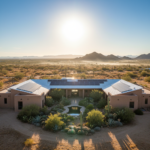
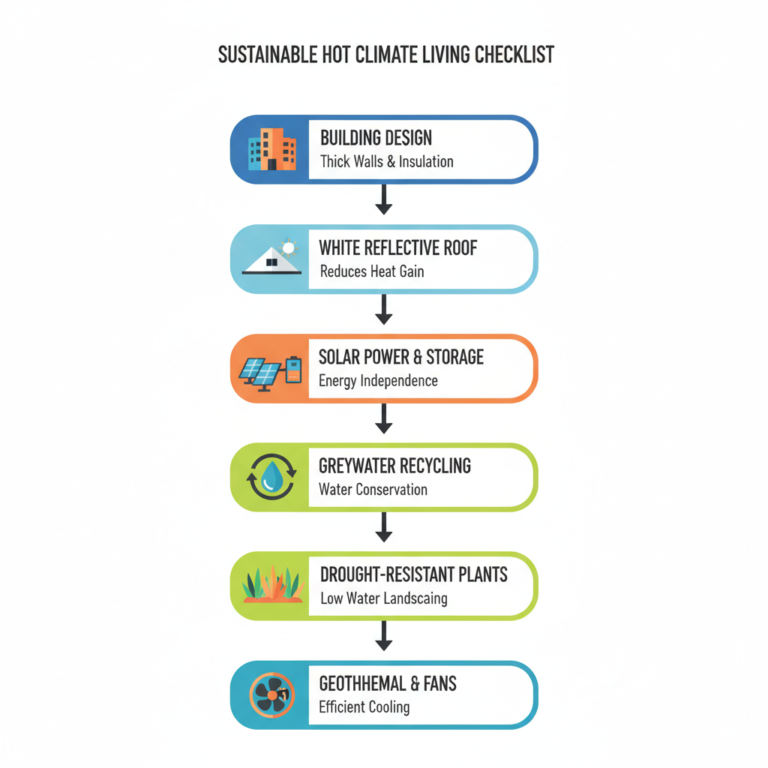
Walk through any old city in a hot region—Marrakech, Cartagena, Jaipur—and you’ll notice something. Thick walls. Small windows. Courtyards. White surfaces everywhere. These weren’t aesthetic choices; they were survival strategies.
The Physics of Staying Cool
Heat enters your home three ways: through the roof, through the walls, and through the windows. Stop it there, and you’ve won most of the battle.
Thermal mass is your friend. Think of it as a thermal battery. Materials like adobe, rammed earth, or concrete absorb heat slowly during the day and release it at night when temperatures drop. I’ve measured 15°C differences between outdoor and indoor temperatures in properly designed thermal mass homes—with zero mechanical cooling.
White roofs aren’t just pretty. A dark roof in summer can reach 80°C. A white or reflective roof? Maybe 50°C. That 30-degree difference translates directly to how much heat pumps into your home. Some reflective coatings can cut cooling costs by 40%.
Windows are thermal holes. I know, you want those views and natural light. But consider this: single-pane glass in direct sun transfers heat like it’s trying to. Double-glazing with low-e coatings blocks up to 70% of heat gain while still letting light through. Add external shading—awnings, shutters, or even well-placed trees—and you’ve eliminated your biggest heat source.
Cross-ventilation sounds basic because it is. But basic works. Position windows opposite each other, especially on the prevailing wind direction. Hot air rises, so high-level vents or windows let it escape while pulling cooler air through lower openings. It’s a convection current that costs nothing to run.
Materials That Actually Make Sense
Forget the Pinterest-perfect aesthetics for a moment. What performs?
Bamboo grows absurdly fast (some species hit 90cm in a single day), sequesters carbon, and creates naturally insulated structures. Cork—actual tree bark that regrows—insulates better than most synthetic materials. Lime plaster breathes, managing humidity without trapping heat.
The best material? Whatever’s local. Shipping granite from Italy to Texas adds embodied carbon that negates any performance benefits. Local stone, compressed earth blocks, or regionally appropriate woods reduce transportation emissions while supporting local economies.
Renewable Energy Isn’t Optional Anymore
Let me be blunt: if you live in a hot climate and don’t have solar panels, you’re leaving money on the table. The payback period in sunny regions runs 4-7 years. The panels last 25-30 years. The math is simple.
Modern solar installations during peak sun hours—exactly when air conditioners work hardest—generate the most power. It’s almost poetic. Your problem becomes your solution.
Battery storage changes everything. Earlier systems fed excess power to the grid, which was fine until grids started failing during extreme heat. Now you can store that midday energy surplus and use it during evening peak hours or outages. We’re talking about genuine energy independence.
Rethinking Cooling Completely
Air conditioning is expensive, energy-intensive, and creates heat islands in cities. But you knew that. What you might not know is how many alternatives actually work.
Evaporative cooling uses physics instead of compressors. Water evaporating into air creates a cooling effect—the same reason sweat works. In dry climates (under 50% humidity), these systems can drop temperatures 15-20°C while using 75% less electricity than traditional AC. The catch: they don’t work well in humid heat. Can’t cheat thermodynamics.
Geothermal systems tap into earth’s constant underground temperature (roughly 15-20°C year-round). Pipes buried 2-3 meters deep circulate fluid that absorbs or releases heat. Installation costs more upfront but operating costs are minimal. I’ve seen whole-house cooling for the electricity cost of running a couple of light bulbs.
Radiant cooling runs chilled water through ceiling panels, cooling you directly rather than cooling all the air in a room. It’s more efficient and feels more comfortable—no dry air, no drafts, no noise.
Ceiling fans deserve more respect. A fan doesn’t cool air; it cools you by increasing evaporation from your skin. That means you can set thermostats higher (each degree saves roughly 3% on cooling costs) while staying comfortable. Strategic fan placement—bedroom, living room, home office—costs pennies to run.
Water: The Other Crisis
Energy gets all the attention. Water deserves more.
Hot climates are often water-scarce. Population growth and climate change are making this worse. The UN projects that by 2030, half the world’s population will face water stress. Many of those people live in hot regions.
Rainwater harvesting isn’t complicated. Gutters lead to storage tanks. Basic filtration removes debris. Pumps distribute water for irrigation, toilet flushing, even washing machines. A 200-square-meter roof can collect over 100,000 liters annually in areas receiving just 500mm of rain. That’s a substantial portion of household needs.
Greywater systems reuse water from showers, bathroom sinks, and washing machines. With simple treatment (sometimes just a filter and settling tank), this water irrigates gardens. You’re using the same water twice. A family of four generates 400-600 liters of greywater daily—enough to maintain significant landscaping even in drought conditions.
Xeriscaping—landscaping with drought-adapted plants—eliminates the madness of watering lawns in deserts. Native plants evolved for your climate. They survive on rainfall alone once established. Bonus: they support local pollinators and require zero fertilizers or pesticides.
Growing Food When Hell Is Outside
I won’t pretend this is easy. But people have been growing food in hot climates since agriculture began.
Timing matters more than anything. Plant cool-season crops (lettuce, peas, broccoli) during your milder months. Reserve peak summer for heat-lovers: okra, eggplant, peppers, melons. Tomatoes are tricky—they need warmth but above 35°C, pollen becomes unviable. Shade cloth fixes this.
Hydroponics and aquaponics eliminate soil, reduce water usage by 90%, and can be positioned in climate-controlled spaces. Initial setup costs more, but yields are higher and year-round. I’ve seen balcony hydroponic systems in Dubai producing more vegetables than traditional gardens triple their size.
Drip irrigation delivers water directly to roots, eliminating evaporation loss. Simple manual systems cost under $100 for a decent-sized garden. Automated systems with moisture sensors ensure plants get exactly what they need—no more, no less.
Mulch is unglamorous but critical. A 10cm layer of organic mulch reduces soil evaporation by up to 70%, moderates soil temperature, and improves soil structure as it breaks down. Wood chips, straw, shredded leaves—anything works.