My electricity bill used to give me anxiety. Not the “oh, this is mildly annoying” kind—the genuine stomach-drop variety. Month after month, I’d watch the numbers creep higher while feeling completely powerless to stop them.
Then I started making changes. Small ones at first. Nothing dramatic, nothing that required me to take out a second mortgage or live like a cave dweller. Within three months, my bill had dropped by 42%. A year later? I’m consistently saving over $600 annually, and my home is more comfortable than it’s ever been.
This isn’t some feel-good story about sacrifice and deprivation. These are practical, tested strategies that work whether you rent a studio apartment or own a four-bedroom house. Most cost less than a nice dinner out. Some are completely free.
The financial savings are real. But here’s what surprised me: once you start paying attention to energy use, it becomes almost addictive. You notice patterns. You spot waste everywhere. And you realize that our daily habits—multiplied across millions of homes—are either slowly cooking the planet or helping to cool it down.
You get to choose which side you’re on.
Why This Actually Matters (Beyond Saving Money)
Every kilowatt-hour you don’t use stays in your bank account. That part’s obvious. But it also means one less kilowatt-hour needs to be generated, transmitted, and billed. Depending on where you live, that electricity probably came from burning natural gas or coal. Less demand means fewer emissions pumped into the atmosphere.
I’m not asking you to become an environmental crusader. But if you could save hundreds of dollars per year while simultaneously reducing your carbon footprint, why wouldn’t you?
The mental shift happened for me when I stopped seeing energy conservation as restriction and started viewing it as optimization. It’s not about doing without—it’s about eliminating waste you never needed in the first place.
Start Here: The Changes That Deliver Immediate Results
Replace Your Light Bulbs (Yes, Really)
I know you’ve heard this before. Everyone talks about LED bulbs. But have you actually switched them out?
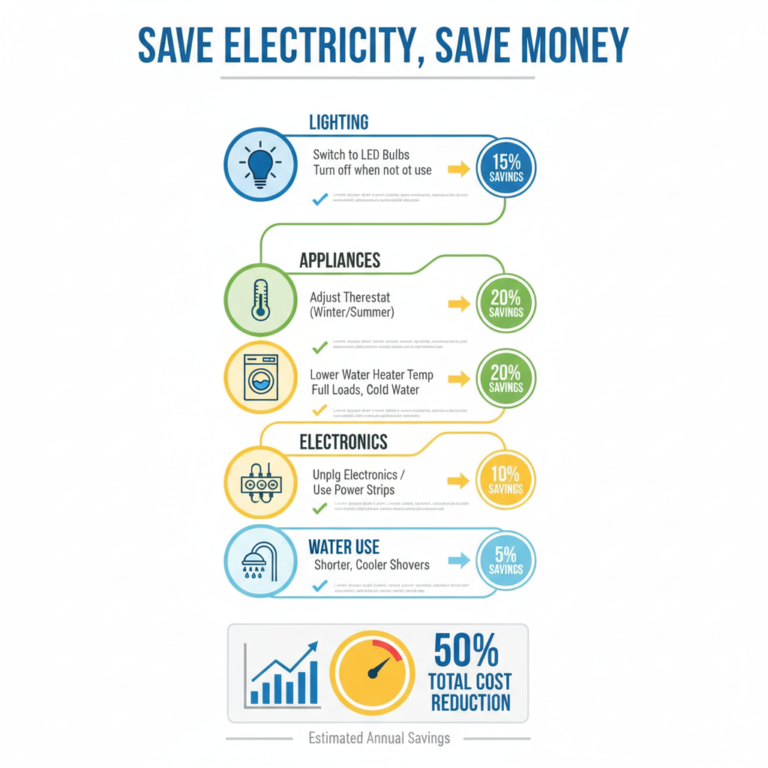
Traditional incandescent bulbs convert 95% of their energy into heat. Only 5% becomes actual light. You’re essentially paying to heat your house with the world’s least efficient space heaters while coincidentally getting a bit of illumination as a side effect.
LED bulbs flip this equation. They use 75% less electricity and last 25 times longer. That bulb you install today? You might not replace it until 2035.
Don’t try to swap every bulb in your house at once. Start with the fixtures you use most—kitchen ceiling lights, living room lamps, bathroom vanities. Those five or six bulbs account for the majority of your lighting costs. The payback period is typically under a year, sometimes just months.
The light quality has improved dramatically too. Those harsh, bluish LEDs from a decade ago? Gone. Modern options produce warm, natural light that’s indistinguishable from traditional bulbs.
Kill the Energy Vampires
Right now, scattered throughout your home, dozens of devices are quietly sipping electricity. Your phone charger. The microwave. That TV you turned “off” with the remote. Gaming consoles. Desktop computers. Cable boxes.
They’re drawing what’s called standby power—just enough to stay ready for your next command. Individually, each device consumes almost nothing. Collectively, they’re responsible for roughly 10% of residential electricity use. For the average American household, that’s about $100 vanishing annually into phantom power.
The fix is stupid simple: plug things into power strips and flip the switch when you’re done. I keep one strip for all my kitchen appliances and another for entertainment center equipment. At night, both get switched off. Takes three seconds, saves hundreds per year.
For devices you’d rather not fuss with, smart plugs can automatically cut power on a schedule. Set it once, forget about it, reap the rewards.
Get Strategic With Your Thermostat
Your heating and cooling system is the energy-hungry elephant in the room. In most homes, it accounts for 40-50% of total electricity consumption.
You don’t need to roast in summer or freeze in winter. You just need to stop heating or cooling an empty house to your ideal comfort temperature.
When you’re sleeping, your body temperature naturally drops. You don’t need the house as warm. When you’re away at work, nobody’s there to feel comfortable. Adjusting your thermostat by 7-10°F during these periods cuts heating and cooling costs by roughly 10% annually.
A programmable thermostat automates this completely. Set your schedule once—it learns when you’re typically home and adjusts accordingly. You’ll never think about it again, but you’ll notice the savings immediately.
For about $120, a smart thermostat like Ecobee or Nest takes this further. Mine learned my patterns within two weeks and now handles everything automatically. If I’m traveling, I can adjust it from my phone. If I come home early, it senses my phone’s proximity and starts adjusting before I arrive.
First-year savings typically run 10-15%, which means these devices pay for themselves quickly.
The Water Heater: Your Third-Biggest Energy Expense (That You Probably Ignore)
Most people don’t think much about their water heater until it breaks. Meanwhile, it’s quietly responsible for 14-18% of your home’s energy consumption.
Turn It Down
Right now, your water heater is probably set to 140°F because that’s the factory default. But 120°F is perfectly adequate for showers, dishwashing, and laundry. You won’t notice the difference, but you’ll cut water heating costs by 6-10% immediately.
Find the dial (usually on the side of the tank), turn it to 120°F, and you’re done. Took me two minutes.
Install Better Showerheads
Standard showerheads blast out 2.5 gallons per minute. Modern low-flow models use under 2.0 gpm while maintaining perfectly satisfying water pressure through clever aerator designs.
I was skeptical about this one. I didn’t want some pathetic trickle shower. But after installing WaterSense-labeled heads throughout my house, I genuinely can’t tell the difference. The shower feels exactly the same, but I’m using 20-30% less hot water.
For an average family, that translates to about 2,700 gallons of water saved annually and roughly 330 kWh less electricity needed to heat it.
Cost? Maybe $20-40 per showerhead. Installation? Unscrew the old one, screw on the new one. Five minutes.
Rethink Your Shower Duration
I know. Long showers are one of life’s great pleasures. I’m not asking you to give them up entirely.
But if you currently take 10-minute showers, cutting them to six saves 3,650 gallons of water per year—just for one person. Multiply that by everyone in your household and the savings compound quickly.
Try this: play one song. When it ends, you’re done. Or set a timer. You’ll adapt faster than you expect.
Appliance Optimization: Work Smarter, Not Harder
Only Run Full Loads
Your dishwasher and washing machine use nearly the same amount of water and energy whether they’re half-full or completely loaded. Running them partially full means you’re essentially paying double for the same amount of cleaning.
Wait until you have full loads. You’ll automatically run these appliances less frequently, saving energy and extending their lifespan.
Cold Water Washing
Modern detergents are specifically engineered for cold water. Unless you’re dealing with heavily soiled items that need sanitizing, cold water cleans just as effectively as hot.
By eliminating hot water from your laundry routine, you could prevent about 1,600 pounds of CO2 emissions annually. Your clothes will also last longer—hot water breaks down fabrics faster.
This change is literally free. Just turn the dial to cold. Done.
Air-Dry Your Laundry (At Least Sometimes)
Clothes dryers account for about 6% of residential electricity use. They’re massive energy hogs.
You don’t need to become a full-time air-dryer evangelist. Just drying half your loads naturally makes a meaningful dent.
Outdoor clotheslines give you that incredible sun-dried smell. Indoor drying racks work perfectly during rain or winter. I keep a folding rack in my laundry room and use it for delicates, workout clothes, and jeans. The dryer handles towels and bed linens.
Use Your Dishwasher (Seriously)
This surprises people, but modern dishwashers actually use less water and energy than hand-washing—typically about half as much.
The key is running full loads and skipping the heated drying cycle. After the rinse completes, just pop the door open